Windmills
Windmills have a long and fascinating history that spans over a thousand years.
1. Ancient Civilizations:
The concept of harnessing wind energy dates back to ancient civilizations. Simple wind-powered machines were used in ancient Persia (present-day Iran) as
early as 200 BCE for grinding grain and pumping water. Similar devices were also employed in China and the Middle East.
2. Middle Ages in Europe:
Windmills as we commonly recognize them today began to appear in Europe during the Middle Ages. The earliest documented windmill design dates back to
7th-century Europe. By the 12th century, they had become widespread in parts of France and England. These early European windmills were primarily used
for grinding grains into flour. The Dutch are particularly renowned for their advanced windmill designs during this period.
The horizontal or panemone windmill first appeared in Persia during the 9th century, and the vertical windmill first appeared in north western Europe in the
12th century.
3. Industrial Revolution:
During the 18th and 19th centuries, the Industrial Revolution spurred innovations in windmill technology. Wind power was used for a variety of
industrial applications, such as milling, sawing wood, and processing textiles. Sail-winged windmills, similar to those used by the Dutch, became
popular in England during this time.
4. 19th and 20th Centuries:
In the 19th century, as steam power became more prevalent, windmills saw a decline in industrial usage in Europe and North America. However, they
remained vital in rural areas for pumping water and generating electricity in some cases.
5. Rise of Wind Energy:
In the late 19th and early 20th centuries, the United States experienced a resurgence of windmill use on farms, particularly in the Midwest. Steel
windmills became common for pumping water and were widely used until rural electrification took place in the mid-20th century.
6. Modern Wind Energy:
The late 20th century witnessed a significant revival of interest in wind energy as concerns about environmental pollution and fossil fuel depletion grew.
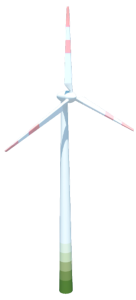
Advances in materials, aerodynamics, and electronics led to the development of modern wind turbines. These turbines are much larger and more efficient
than traditional windmills, and they can generate electricity on a large scale. Offshore wind farms, in particular, have become a major source of renewable
energy in several countries.
Today, wind energy is a booming industry, providing a substantial portion of the world's renewable energy. Wind turbines continue to evolve, becoming
more efficient and cost-effective, contributing significantly to the global efforts to combat climate change and transition to sustainable energy sources.
Windmills are structures that convert wind power into rotational energy using vanes called sails or blades, specifically to mill grain (gristmills), but the
term is also extended to windpumps, wind turbines, and other applications, in some parts of the English speaking world.
Vertical UK windmills date back to 1185 with the first known mill in the former village of Weedley in Yorkshire, close to the Humber Estuary.
There are a number of different types of vertical mill - Post Mills, Hollow-Post Mills, Sunk post mills, Open trestle post mills, Midlands post mills, Tower
Mills and Smock Mills.
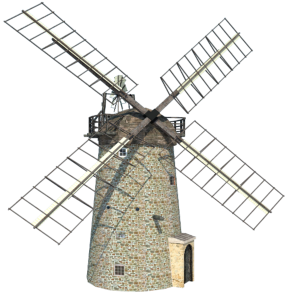
Ruiton Windmill is an example of a Tower Mill.
Hollow-post mill
In a hollow-post mill, the post on which the body is mounted is hollowed out, to accommodate the drive shaft.
This makes it possible to drive machinery below or outside the body while still being able to rotate the body into the wind. Hollow-post mills
driving scoop wheels were used in the Netherlands to drain wetlands from the 14th century onwards.
Post mill
The post mill is the earliest type of European windmill. Its defining feature is that the whole body of the mill that houses the machinery is
mounted on a single vertical post, around which it can be turned to bring the sails into the wind. All post mills have an arm projecting from
them on the side opposite the sails and reaching down to near ground level. With some, as at Saxtead Green, the arm carries a fantail to turn
the mill automatically. With the others the arm serves to rotate the mill into the wind by hand.
Smock mill
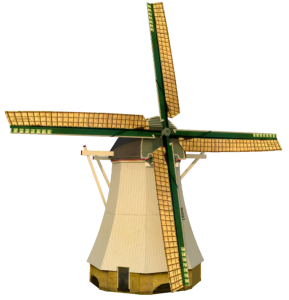
The smock mill is a type of windmill that consists of a sloping, horizontally
weatherboarded, thatched, or shingled tower, usually with six or eight sides. It is topped with a roof or cap that rotates to bring
the sails into the wind. This type of windmill got its name from its resemblance to smocks worn by farmers in an earlier period.
Smock mills differ from tower mills, which are usually cylindrical rather than hexagonal or octagonal, and built from brick or
stone masonry instead of timber. The majority of smock mills are octagonal in plan, with a lesser number hexagonal in plan. A
very small number of smock mills were decagonal or dodecagonal in plan.
Tower mill
A tower mill is a type of vertical windmill consisting of a brick or stone tower,
on which sits a wooden 'cap' or roof, which can rotate to bring the sails into
the wind.
This rotating cap on a firm masonry base gave tower mills great advantages
over earlier post mills, as they could stand much higher, bear larger sails, and thus afford greater reach into the wind. Windmills
in general had been known to civilization for centuries, but the tower mill represented an improvement on traditional western-
style windmills. The tower mill was an important source of power for Europe for nearly 600 years from 1300 to 1900,
contributing to 25 percent of the industrial power of all wind machines before the advent of the steam engine and coal power.
It represented a modification or a demonstration of improving and adapting technology that had been known by humans for
ages. Although these types of mills were effective, some argue that, owing to their complexity, they would have initially been
built mainly by the most wealthy individuals.