Himley Hall
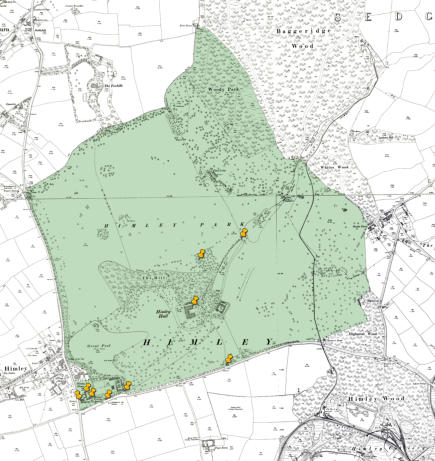
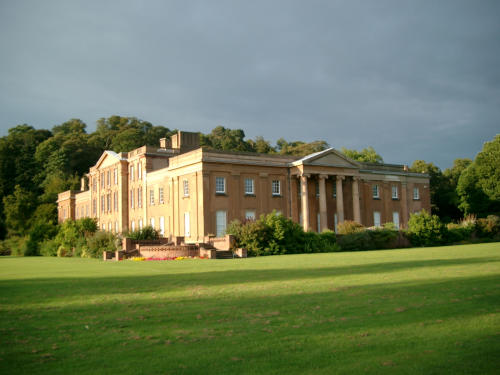
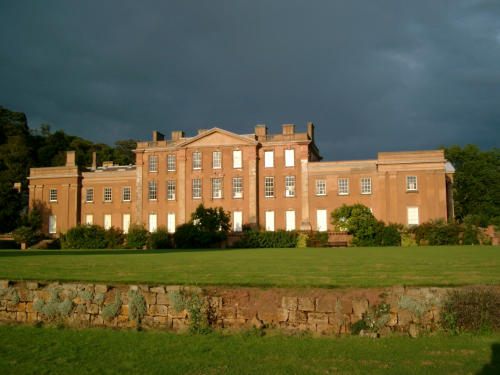
Himley Hall is a Grade II* Listed early 18th-century Georgian country house situated in Staffordshire and formerly home to the Lords of Dudley and their knights.
Grade II Listed are:
The Park and Garden
The bridge between Rock Pool and Island pool
The Ice House
The Entrance Lodges, gates, piers and railings
Frant Lodge at the secondary entrance
The Church of St Michael and All Angels
The Church Rectory
The Rectory Coach House and Stable Block
The wall & railings between the Old Rectory and Frant Lodge.
There was an earlier moated manor house on the site, standing beside the medieval church. This was in the ownership of the Sutton family - the descendents of Ketel de Sutton, a
Norman Knight who first settled in the Village of Holderness near Hull. The Sutton’s inherited Dudley Castle when Sir John de Sutton (1286 - 1338) "1st Lord of Dudley" married
Margaret de Somery - Sir John was a Knight and Lord of Malopassu and Shokelache (now Malpas and Shocklach in Cheshire) Shocklach Castle is of particular importance as one of a
group of early post-Conquest (c.1100) mottes forming a defensive system aimed at curbing constant Welsh raids on the rich farming areas of south Cheshire.
Royal Connections
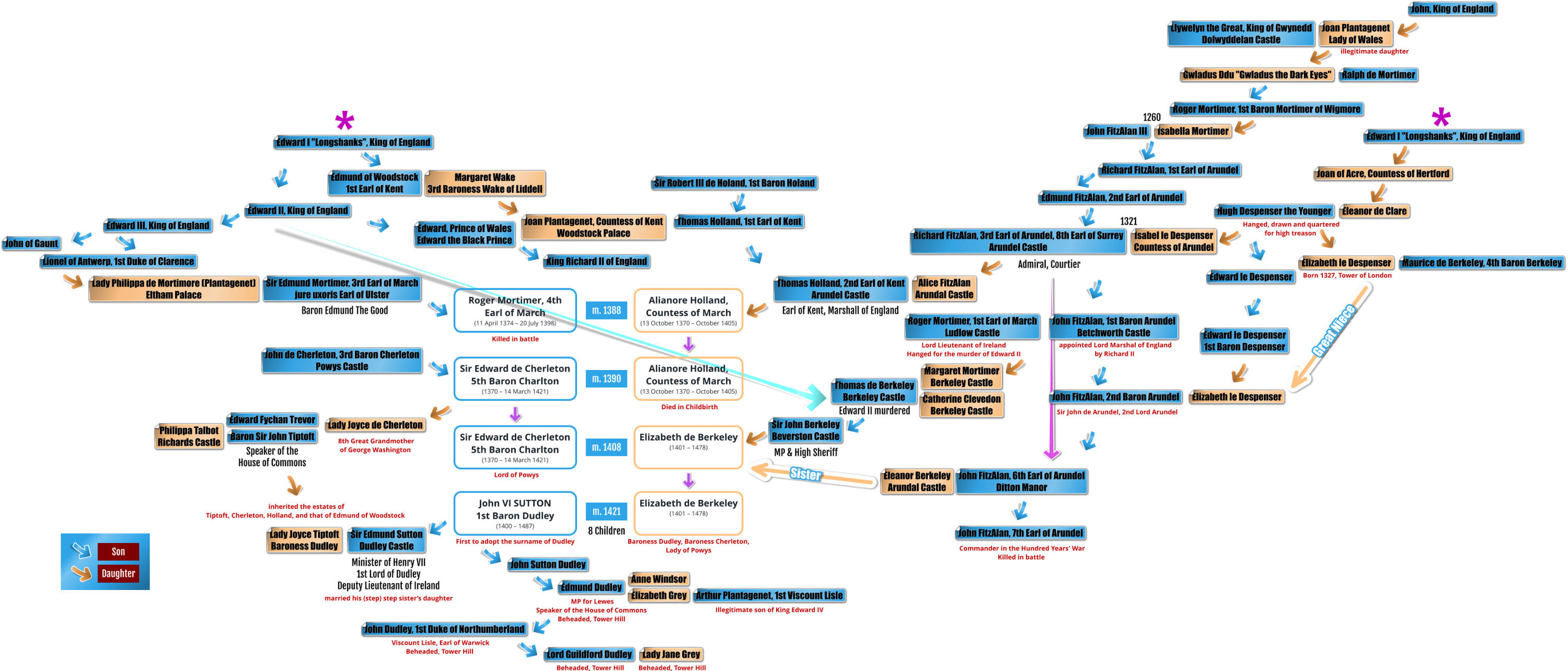
The Sutton family are linked to Royalty on numerous occasions - John de Sutton (1361 - 1396) was just
four generations below Edward I of England. They were linked via the le Despencer and de Clare
families by marriage.
The first of the Sutton family to adopt the name Dudley was Sir John Sutton, 1st Baron Dudley (25
December 1400 – 30 September 1487).
He was an English nobleman, a diplomat, and councillor of King Henry VI. He fought in several battles
during the Hundred Years War and the Wars of the Roses, as well as acting as Lord Lieutenant of
Ireland from 1428 to 1430.
He was the second husband of
Elizabeth de Berkeley following
a run of second marriages for
various reasons. Elizabeth's
Grandfather Thomas de Berkeley,
3rd Baron Berkeley (1296 - 1361)
was the owner of Berkeley Castle
in Gloucestershire when King
Edward II was murdered in his cell there.
The Castle is one of the March Castles, built to keep out the Welsh. The Castle is the oldest building in
the country to be inhabited by the same family who built it.
Sir Edmund Sutton and Lady Joyce Tiptoft were exceptionally well off having inherited four
quarterings (estates) via Baron Sir John Tiptoft, Speaker of the House of Commons, Treasurer of the
Household, Chief Butler of England, Treasurer of the Exchequer and Seneschal of Landes and
Aquitaine. He was also a descendant of Charlemagne.
In 1586 Sir Edmund’s Great Great Grandson Edward Sutton (1567 – 1643) - 5th Baron Dudley inherited
the estate including Dudley Castle.
Edward, aged just 13 was sent to Lincoln College, Oxford and the following year, when only 14 years
old, was married to Theodosia Harington of Exton, Rutland who was about 5 years older. They had five
children, four daughters and one son Sir Ferdinando who only had one child, a daughter Frances (1611 - 1697)
Edward Sutton was the patron of a group of actors, known as Lord Dudley's players and a performing bear.
Sutton’s children lived in Dudley Castle but he also had a mistress Elizabeth Tomlinson with whom he had another 15 children - they lived in Himley Manor House
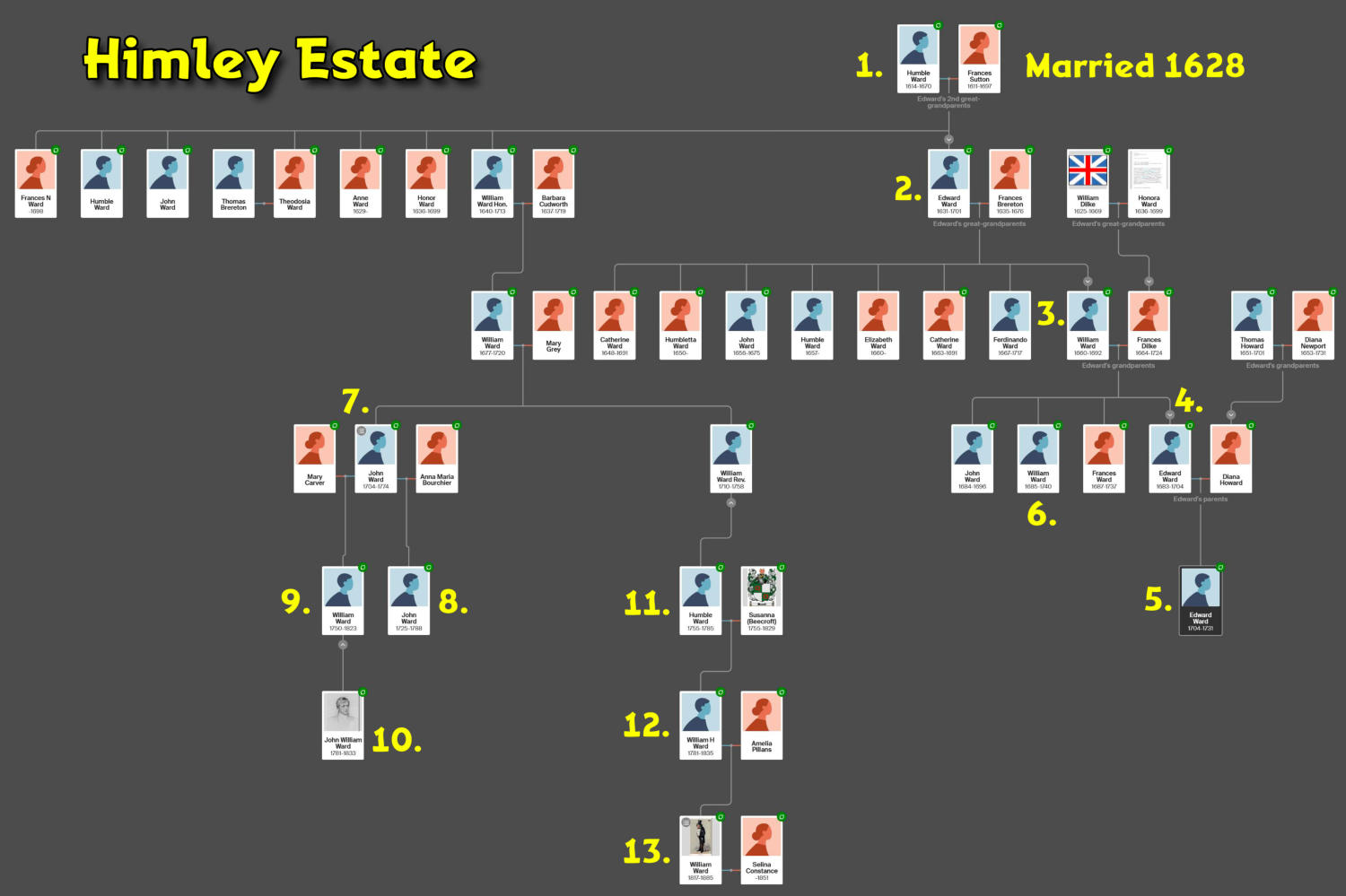
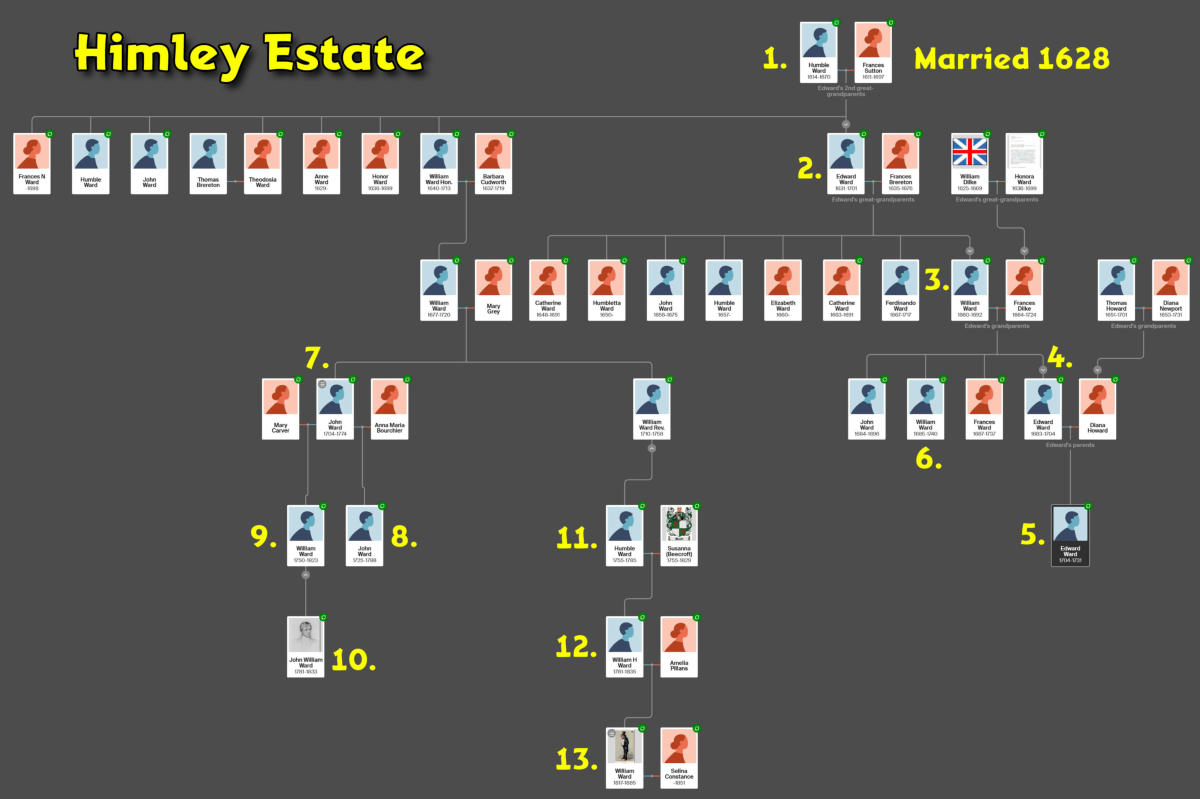
In 1628, the Ward family inherited the title Lords of Dudley through the marriage of Humble Ward (1614 - 1670) to the heiress to the Dudley estates, Frances Sutton (1611 - 1697).
Humble Ward was the son of the jeweller and goldsmith to the court of King Charles I.
The First English Civil War broke out in 1642 between Royalists and Parliamentarians which all started when Charles I
attempted to impose uniform practices across England, Scotland and Ireland in 1637. The Scottish Bishops rebelled in 1639
and the Irish in 1641 which ultimately led to the outbreak between all three nations in 1642. Following damage to Dudley
Castle during the Civil War, Himley Hall became the principal family home.
In 1645, King Charles I encamped in the grounds at Himley on his way to defeat at the Battle of Naseby.
The Himley Estate bounced around in ownership as a number of the Ward family died without children to inherit the property.
When 9th Baron Edward Ward died (1704 - 1731) leaving no heirs, the estate passed to his
Uncle, 10th Baron William (1685 - 1740) who also died leaving no heirs so the estate then
passed to his cousin John 1st Viscount and Dudley Ward (1704 - 1774)
John Ward demolished the medieval manor in 1740 to make way for a great Palladian
mansion. The village of Himley was relocated at this time, and its parish church rebuilt on its
present site in 1764. Most recent Earls of Dudley are interred in a private burial ground at the
rear of this church.
When John Ward died in 1774 and was succeeded by his son John, 2nd Viscount and Dudley
Ward (1725 - 1788), he commissioned Capability Brown to redesign the 180 acres (730,000
m2) of parkland. Changes in Brown's 1779 plans included the addition of a lake, fed by a
series of waterfalls from a higher chain of smaller pools.
John Ward also died leaving no heirs so the estate then went to his half brother William 3rd Viscount and Dudley (1750 - 1823).
When he died the estate passed on to John William Ward (1781 - 1833) - 1st Earl of Dudley and he also died leaving no heirs so
it passed on to his cousin William Humble Ward (1781 - 1835)- 10th Baron Ward
William Humble Ward enlarged the hall between 1824-7 designed by Architect William Atkinson which added flanking wings
on an east-west alignment, attached to the main house by short links. The resulting structure encloses 3 sides of an eastern
entrance courtyard.
The family left Himley in the 1830s, because it was too close to the Black Country. They instead lived in great grandeur on their
mineral wealth at Witley Court at Great Witley in Worcestershire.
In 1934, the Duke and Duchess of Kent honeymooned at Himley Hall. King Edward VIII spent his last weekend there before his abdication in 1936.
After the Second World War, the property was sold to the National Coal Board for £45,000 in January 1947, only two hours before it was set to go on the auction block. The board
planned to use as office space for 250 of its West Midlands staff. Three months later, during its conversion for this new purpose, a fire broke out and gutted the South wing. The
house was unoccupied when fire broke out, and all of Lord Dudley's art and furnishings had been removed three days prior. This part of the house was rebuilt, but not according to
its former appearance. The decline in the coal mining industry in the area led to the Hall being once more put on the market.
In 1966, it was purchased jointly by Dudley and Wolverhampton County Borough Councils − despite existing within the Seisdon Urban District (and then South Staffordshire from
1974). The park was opened as a public leisure area. In 1988, Dudley bought Wolverhampton's share, gaining outright ownership.
Set in the grounds of Himley Hall, Himley Park was created in the 1970s and is popular with families and dog walkers. The
Great Pool is a favourite boating lake and the hill with many woodland walks along with open parkland is busy place all year
round.
There is also a nine-hole public golf course which was designed by A & K Baker in 1980 and a family pitch and putt within the
park, along with public fishing on the lake. Himley Hall sailing club have sailed on the Great Lake since 1970 and are a RYA-
registered training centre.
The grounds also host a popular bonfire and fireworks display where a spectacular view can be seen from the top of Ruiton Mill. Himley is a two minute walk from Holbeche House
where the last of the Gunpowder Plotters where captured or killed.




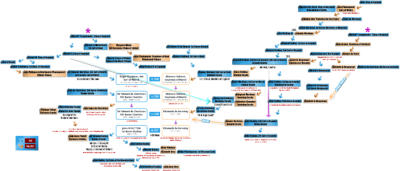





Himley Hall
Himley Hall is a Grade II* Listed early 18th-century Georgian
country house situated in Staffordshire and formerly home to the Lords
of Dudley and their knights.
Grade II Listed are:
The Park and Garden
The bridge between Rock Pool and Island pool
The Ice
House
The Entrance
Lodges, gates, piers
and railings
Frant Lodge
at the secondary
entrance
The Church of St Michael and All Angels
The Church Rectory
The Rectory Coach House and Stable Block
The wall & railings between the Old Rectory and Frant Lodge.
There was an earlier moated manor house on the site, standing beside
the medieval church. This was in the ownership of the Sutton family -
the descendents of Ketel de Sutton, a Norman Knight who first settled in
the Village of Holderness near Hull. The Sutton’s inherited Dudley Castle
when Sir John de Sutton (1286 - 1338) "1st Lord of Dudley" married
Margaret de Somery - Sir John was a Knight and Lord of Malopassu and
Shokelache (now Malpas and Shocklach in Cheshire) Shocklach Castle is
of particular importance as one of a group of early post-Conquest
(c.1100) mottes forming a defensive system aimed at curbing constant
Welsh raids on the rich farming areas of south Cheshire.
Royal Connections
The Sutton family are linked to Royalty on numerous occasions - John de
Sutton (1361 - 1396) was just four generations below Edward I of
England. They were linked via the le Despencer and de Clare families by
marriage.
The first of the Sutton family to adopt the name Dudley was Sir John
Sutton, 1st Baron Dudley (25 December 1400 – 30 September 1487).
He was an English nobleman, a diplomat, and councillor of King Henry
VI. He fought in several battles during the Hundred Years War and the
Wars of the Roses, as well as acting as Lord Lieutenant of Ireland from
1428 to 1430.
He
was the second husband of Elizabeth de Berkeley following a run of
second marriages for various reasons. Elizabeth's Grandfather Thomas de
Berkeley, 3rd Baron Berkeley (1296 - 1361) was the owner of Berkeley
Castle in Gloucestershire when King Edward II was murdered in his cell
there.
The Castle is one of the March Castles, built to keep out the Welsh. The
Castle is the oldest building in the country to be inhabited by the same
family who built it.
Sir Edmund Sutton and Lady Joyce Tiptoft were exceptionally well off
having inherited four quarterings (estates) via Baron Sir John Tiptoft,
Speaker of the House of Commons, Treasurer of the Household, Chief
Butler of England, Treasurer of the Exchequer and Seneschal of Landes
and Aquitaine. He was also a descendant of Charlemagne.
In 1586 Sir Edmund’s Great Great Grandson Edward Sutton (1567 –
1643) - 5th Baron Dudley inherited the estate including Dudley Castle.
Edward, aged just 13 was sent to Lincoln College, Oxford and the
following year, when only 14 years old, was married to Theodosia
Harington of Exton, Rutland who was about 5 years older. They had five
children, four daughters and one son Sir Ferdinando who only had one
child, a daughter Frances (1611 - 1697)
Edward Sutton was the patron of a group of actors, known as Lord
Dudley's players and a performing bear.
Sutton’s children lived in Dudley Castle but he also had a mistress
Elizabeth Tomlinson with whom he had another 15 children - they lived
in Himley Manor House
In 1628, the Ward family inherited the title Lords of Dudley through the
marriage of Humble Ward (1614 - 1670) to the heiress to the Dudley
estates, Frances Sutton (1611 - 1697). Humble Ward was the son of the
jeweller and goldsmith to the court of King Charles I.
The First English
Civil War broke out
in 1642 between
Royalists and
Parliamentarians
which all started
when Charles I
attempted to
impose uniform
practices across England, Scotland and Ireland in 1637. The Scottish
Bishops rebelled in 1639 and the Irish in 1641 which ultimately led to
the outbreak between all three nations in 1642. Following damage to
Dudley Castle during the Civil War, Himley Hall became the principal
family home.
In 1645, King Charles I encamped in the grounds at Himley on his way to
defeat at the Battle of Naseby.
The Himley Estate bounced around in ownership as a number of the
Ward family died without children to inherit the property.
When 9th Baron Edward Ward died (1704 - 1731) leaving no heirs, the
estate passed to his Uncle, 10th Baron William (1685 - 1740) who also
died leaving no heirs so the estate then passed to his cousin John 1st
Viscount and Dudley Ward (1704 - 1774)
John Ward demolished the medieval manor in 1740 to make way for a
great Palladian mansion. The village of Himley was relocated at this
time, and its parish church rebuilt on its present site in 1764. Most
recent Earls of Dudley are interred in a private burial ground at the rear
of this church.
When John Ward died in 1774 and was succeeded by his son John, 2nd
Viscount and Dudley Ward (1725 - 1788), he commissioned Capability
Brown to redesign the 180 acres (730,000 m2) of parkland. Changes in
Brown's 1779 plans included the addition of a lake, fed by a series of
waterfalls from a higher chain of smaller pools.
John Ward also died
leaving no heirs so
the estate then
went to his half
brother William 3rd
Viscount and
Dudley (1750 -
1823). When he
died the estate
passed on to John William Ward (1781 - 1833) - 1st Earl of Dudley and he
also died leaving no heirs so it passed on to his cousin William Humble
Ward (1781 - 1835)- 10th Baron Ward
William Humble Ward enlarged the hall between 1824-7 designed by
Architect William Atkinson which added flanking wings on an east-west
alignment, attached to the main house by short links. The resulting
structure encloses 3 sides of an eastern entrance courtyard.
The family left Himley in the 1830s, because it was too close to the
Black Country. They instead lived in great grandeur on their mineral
wealth at Witley Court at Great Witley in Worcestershire.
In 1934, the Duke and Duchess of Kent honeymooned at Himley Hall.
King Edward VIII spent his last weekend there before his abdication in
1936.
After the Second World War, the property was sold to the National Coal
Board for £45,000 in January 1947, only two hours before it was set to
go on the auction block. The board planned to use as office space for
250 of its West Midlands staff. Three months later, during its conversion
for this new purpose, a fire broke out and gutted the South wing. The
house was unoccupied when fire broke out, and all of Lord Dudley's art
and furnishings had been removed three days prior. This part of the
house was rebuilt, but not according to its former appearance. The
decline in the coal mining industry in the area led to the Hall being once
more put on the market.
In 1966, it was purchased jointly by Dudley and Wolverhampton County
Borough Councils − despite existing within the Seisdon Urban District
(and then South Staffordshire from 1974). The park was opened as a
public leisure area. In 1988, Dudley bought Wolverhampton's share,
gaining outright ownership.
Set in the grounds
of Himley Hall,
Himley Park was
created in the
1970s and is
popular with
families and dog
walkers. The Great
Pool is a favourite
boating lake and
the hill with many woodland walks along with open parkland is busy
place all year round.
There is also a nine-hole public golf course which was designed by A &
K Baker in 1980 and a family pitch and putt within the park, along with
public fishing on the lake. Himley Hall sailing club have sailed on the
Great Lake since 1970 and are a RYA-registered training centre.
The grounds also host a popular bonfire and fireworks display where a
spectacular view can be seen from the top of Ruiton Mill. Himley is a two
minute walk from Holbeach House where the last of the Gunpowder
Plotters where captured or killed.