Local Geology
Although Ruiton Mill sits on Ludlow sandstone, the area around Ruiton, Gornal & Dudley is a mixture of different rock formations from different eras. Major events over the course of history of the planet have shaped what we see today and the length of time is measured in ‘millions of years ago’ so the Ludlow stone the Mill sits on was formed around 425 million years ago during the Ludlow Epoch. The Ludlow Epoch was a length of time during the Silurian Period which was itself a section of time during the Paleozoic Era. The sections of time are further broken down as: The current age is the Meghalayan - part of the Holocene Epoch which is part of the Quaternary Period and the Cenozoic Era which is a section of the Phanerozoic Eon To give this timescale some perspective, the UK only split from mainland Europe in the last Age - the Northgrippian - this is of course the land mass of the UK and nothing to do with Brexit. Although sixty six million years ago, we are also still in the same Eon as the Dinosaurs although they were present in the Mesozoic Era The graphic below shows the different types of rock that makes up the Gornal area and the numbers represent the number of million years old the rock is. A seam of Silurian Limestone makes up Sedgley Beacon with Ludlow Sandstone at Upper Gornal (or ‘Gornal Grit’) Lower Gornal is mostly Pennine Lower and Middle coal seams. When the dinosaurs were wiped out by a 6.2 mile wide asteroid hitting Mexico forming the 110 mile wide and 12 mile deep Chicxulub crater thereby ending the Cretaceous period, Gornal rock was already 359 million years old. 86 million years before Gornal Rock was formed the Ordovician extinction wiped out many of the Trilobites (Calymene blumenbachii) - or the Dudley Bug as we like to call it. Back then Dudley was a shallow sea. Over 700 types of fossil are known to have come from Wren's Nest.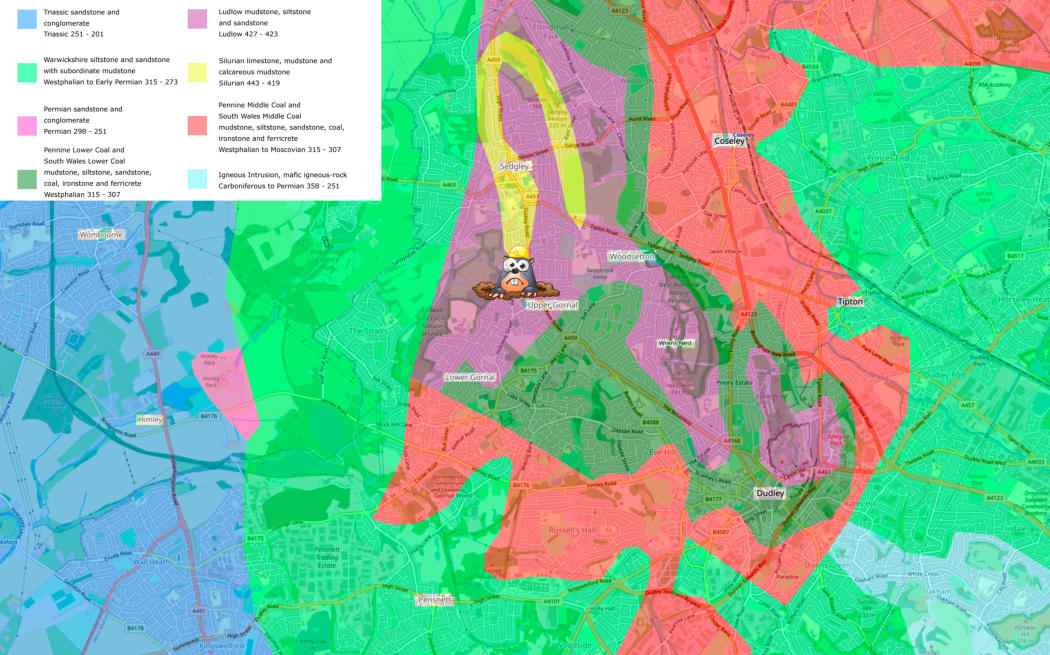

Eon
Era
Period
Epoch
Age

Local Geology
Although Ruiton Mill sits on Ludlow sandstone, the area around Ruiton, Gornal & Dudley is a mixture of different rock formations from different eras. Major events over the course of history of the planet have shaped what we see today and the length of time is measured in ‘millions of years ago’ so the Ludlow stone the Mill sits on was formed around 425 million years ago during the Ludlow Epoch. The Ludlow Epoch was a length of time during the Silurian Period which was itself a section of time during the Paleozoic Era. The sections of time are further broken down as: The current age is the Meghalayan - part of the Holocene Epoch which is part of the Quaternary Period and the Cenozoic Era which is a section of the Phanerozoic Eon To give this timescale some perspective, the UK only split from mainland Europe in the last Age - the Northgrippian - this is of course the land mass of the UK and nothing to do with Brexit. Although sixty six million years ago, we are also still in the same Eon as the Dinosaurs although they were present in the Mesozoic Era The graphic below shows the different types of rock that makes up the Gornal area and the numbers represent the number of million years old the rock is. A seam of Silurian Limestone makes up Sedgley Beacon with Ludlow Sandstone at Upper Gornal (or ‘Gornal Grit’) Lower Gornal is mostly Pennine Lower and Middle coal seams. When the dinosaurs were wiped out by a 6.2 mile wide asteroid hitting Mexico forming the 110 mile wide and 12 mile deep Chicxulub crater thereby ending the Cretaceous period, Gornal rock was already 359 million years old. 86 million years before Gornal Rock was formed the Ordovician extinction wiped out many of the Trilobites (Calymene blumenbachii) - or the Dudley Bug as we like to call it. Back then Dudley was a shallow sea. Over 700 types of fossil are known to have come from Wren's Nest.


- News
- Bookings
- History
- Galleries
- The Area
- The Mill
- Friends
- Contact
