A Rich History
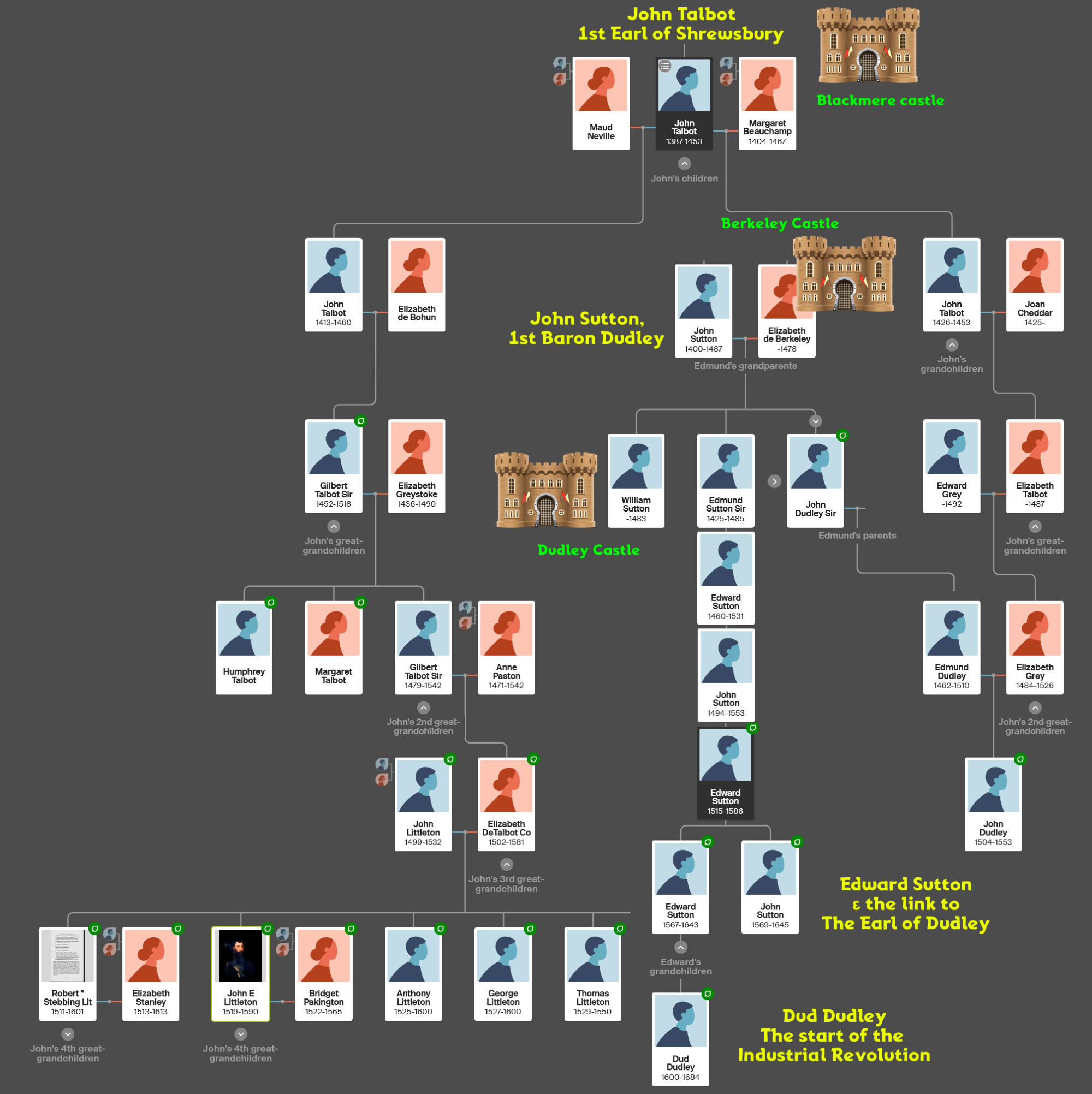
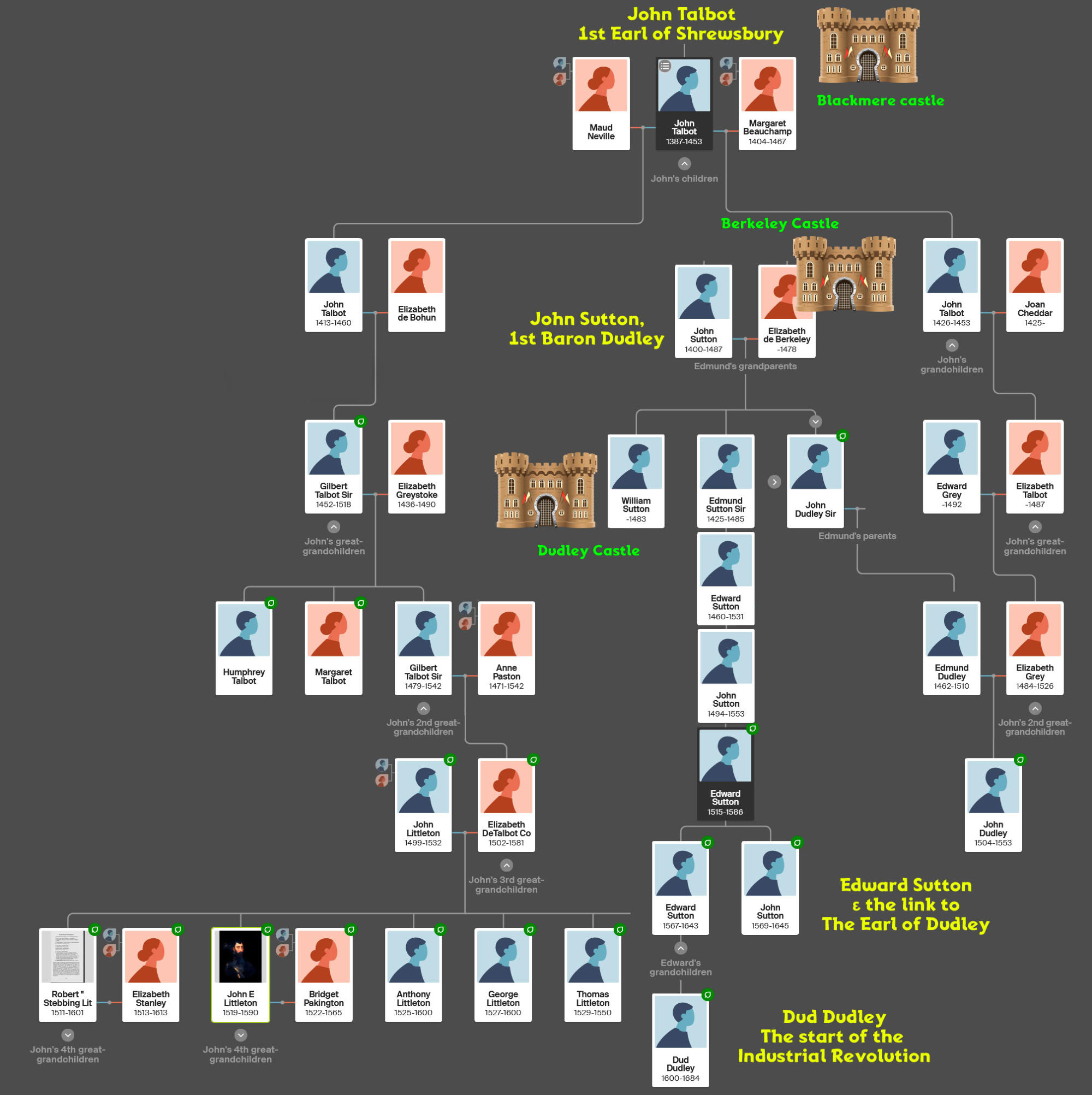
The Sutton’s, The Talbot’s, The Lyttleton’s & the Ward’s Dudley, Gornal, Sedgley and the surrounding areas have a rich history linking not only the wealthy landowners and their stately homes & castles but also royalty, industrialists, parliamentarians and religious leaders - in fact Prime Ministers such as William Gladstone are linked to Princess Diana and Princess Diana is linked to the Gunpowder Plot. The first Dudley Castle dates back to 1070. It is first mentioned in the Domesday Book and is noted as being in the possession of William Fitz-Ansculf albeit this was a timber castle not the stone version that exists today. Dudley was first used for a peerage in 1341 when John de Sutton (1329- 1369) became the first Lord Dudley of Dudley Castle. The Sutton Family can be traced back to Ketel de Sutton, a Norman Knight who first settled in the Village of Holderness near Hull. The name Sutton comes from Anglo Saxon Sudtone, or Southtown and as such most Counties in England have one or more placenames bearing the prefix "Sutton". In 1327 Edward II was murdered in Berkeley Castle in Gloucestershire when Thomas de Berkeley, 3rd Baron Berkeley owned Berkeley Castle. His grand daughter Elizabeth de Berkeley (1401 - 1478) married John de Sutton, 1st Baron Dudley (1400 - 1487) to become the first Lady Dudley. John de Sutton, 1st Baron Dudley (1400 - 1487) was an English nobleman, a diplomat and councillor of King Henry VI. He fought in several battles during the Hundred Years War and the Wars of the Roses. Sutton was the first to adopt the surname of Dudley as an alias for Sutton and in 1440 was summoned to Parliament as 'Johanni de Sutton de Duddeley militi' where he became the 1st Lord Dudley. Edmund Dudley (1462 - 1510) John Sutton's grandson, was an English administrator and a financial agent of King Henry VII. He served as a leading member of the Council Learned in the Law, Speaker of the House of Commons and President of the King's Council. After the accession of Henry VIII, he was imprisoned in the Tower of London and executed the next year on a treason charge. While waiting for his execution he wrote The Tree of Commonwealth. Edmund Dudley was also the grandfather of Robert Dudley, 1st Earl of Leicester, a favourite of Henry VIII's daughter, Elizabeth I. Edmund married Elizabeth Grey, 6th Baroness Lisle who was the daughter of Sir Edward Grey and Elizabeth Talbot. The Talbot family were Knights to Royalty, then courtiers, Barons and later to become the Earls of Shrewsbury. Edmund & Elizabeth’s son John Dudley, 1st Duke of Northumberland (1504 - 1553) was also executed (beheaded) in the Tower of London as were his son Lord Guildford Dudley, Lord of Dudley Castle (1535 - 1554) and Daughter in Law Lady Jane Grey (1537 - 1554) for High Treason having treacherously assumed the title and the power of the monarch - Lady Jane Grey had been (disputed) Queen for nine days. Lady Jane Grey was the Great Grand Daughter of Henry VII and she was succeeded by Mary I, Daughter of Henry VIII. John Dudley, 1st Duke of Northumberland (1504 - 1553) Edmund's son, was an English general, admiral, and politician, who led the government of the young King Edward VI from 1550 until 1553 John de Sutton had 11 children which included William, born in Dudley Castle who became the Bishop of Durham and who is buried in Westminster Abbey. Sir Oliver Sutton was a Knight who died at the Battle of Edgecote near Banbury. Edward Sutton, 5th Baron Dudley (1567 - 1643) was a major landowner, mainly in Staffordshire and Worcestershire, and briefly a Member of the House of Commons of England. Edward was the great, great, great grandson of John de Sutton and although his grandfather was considered a pauper and national laughing-stock who had lost Dudley Castle to his cousin, Edward's father had managed to regain ownership. Although Edward was distantly related to the Lyttleton family, he had fallen out with the Worcestershire arm of the family over property deals. Despite Edwards being married to Theodosia Harington and producing five children, he also had a long term relationship with Elizabeth Tomlinson and produced a further eleven, one of which was Dud Dudley (1600 – 1684) who fought on the Royalist side in the English Civil War as a soldier, military engineer, and supplier of munitions. He was one of the first Englishmen to smelt iron ore using coke. Dud grew up at Himley Hall and due to the abundance of good quality coal, ironstone and Gornal Grit later created furnaces and forges all over the Black Country including Pensnett, Cradley and Gornal producing ironworks for the Tower of London. Edward's male lineage with his wife Theodosia ended with their son 10th Baron, Sir Ferdinando Dudley, and Dudley Castle passed to his daughter, Frances Sutton, Baroness Dudley (1611–1697) Frances married Humble Ward (1614 - 1670) who later became 1st Baron Ward. The Barons Ward was created in 1644 with a succession of the Ward family until the Viscount Dudley & Ward was created in 1763 and then the 1st Earl of Dudley was created in 1827 with John William Ward (1781 - 1833) By this time the family had created great wealth and owned most of the coalfields in Staffordshire. The Lyttleton’s The Lyttleton’s were linked to the Talbot’s when Sir John Littleton (1499 - 1532) married Lady Elizabeth de Talbot, Countess of Kent (1502 - 1581) Sir John was using the spelling Littleton to differentiate form the other arms of the family The Lyttletons were a huge dynasty comprising of three main branches: 1. The Pillaton / Hatherton branch 2. The Frankly / Hagley branch 3. Stoke Milurgh branch All were descended from the Knight Sir Thomas Littleton (1407 - 1481) , otherwise known as Thomas de Lyttleton or Thomas Wescote. The family originated from South Lyttleton near Evesham in Worcestershire. With the marriage of the heiress Elizabeth Littleton to Thomas Westcote esquire, two of Elizabeth's sons, Sir Thomas and Edmund, took the surname Lyttleton or Littleton while two others, Nicholas and Guy, retained the earlier surname Westcote. The de Lyttleton’s can be traced back to John de Lyttleton who was born in 1140 The family had moved to Frankly by 1422 when Elizabeth’s father Thomas de Lyttelton IV died. Elizabeth’s son Thomas married Joan Burley who was the daughter of William Burley MP from Boncroft Castle in Shropshire. Joan was the widow of Sir Philip Chetwynd of Ingestre, Staffordshire. Sir Philip was a Knight who died in Calais, France. The current Ingestre Hall was formerly the seat of the Earls Talbot and then the Earls of Shrewsbury, the hall is now owned by Sandwell Metropolitan Borough Council. Gunpowder Plotters Stephen Littleton (1575-1606) was the cousin of John Littleton (1563 - 1601). John Littleton joined in 1601 with Robert Catesby and Robert Devereux, 2nd Earl of Essex's rebellion against Queen Elizabeth I. Catesby later Joined Guy Fawkes and eleven others in an attempt to blow up the Houses of Parliament on the 5th November 1605 but were discovered and most fled to Northamptonshire. By this time Stephen Littleton had inherited Holbeche House at Himley where the fugitves arrived after picking up food & weapons from Warwick Castle and Coughton Court. The King's men arrived at Holbeche on the 8th November and killed or captured most of the plotters. It is believed that the remaining two plotters were harboured at Coopers Bank Farm in Gornal, one of Stephen's tenant farmers before moving on to Humphrey Littleton's house at Hagley Park where they were finally captured. Both Stephen and his uncle Humphrey were executed (hanged, drawn and quartered) on the 7th April 1606 for their part in hiding the plotters. Stately Homes associated with the families Hawarden Castle - built in 1752–57 for Sir John Glynne, 6th baronet later sold to former British prime minister William Gladstone Althorp - Grade I listed stately home and estate in the ownership of the Spencer family since 1508 Hagley Hall is a Grade I listed 18th-century house, creation of George, 1st Lord Lyttelton (1709–1773) built in 1754 Holbeche House - Grade II* listed house constructed in around 1600 where 4 members of the Gunpowder Plot group were killed and 7 wounded and captured. Owned by Stephen Lyttelton who was Executed (hanged, drawn and quartered) in 1606 Teddesley Hall & Park built by Sir Edward Littleton, the fourth to hold the baronetcy, who succeeded in 1742 Wollaton Hall - Elizabethan country house built between 1580 and 1588 for Sir Francis Willoughby who married Lady Elizabeth Lyttleton Tixhall Hall - Tixall Hall was demolished in 1927. The gatehouse is now a Grade I listed building. Tixall was used as a prison for Mary, Queen of Scots for two weeks in 1586 Grafton Manor - Henry de Grafton in 1166 - 1367 Stafford family - 1400's Talbot family - Elizabeth Talbot married Sir John Lyttleton Broncroft Castle - Broncroft Castle is a late 14th century stone fortified manor house, founded by Sir Roger Burley. In the Civil War, the castle was garrisoned by the Royalists until 1645 Pillaton Hall - Winnesbury family, Alice Winnesbury, Heiress of Pillaton married Sir Richard de Lyttleton 1443-1516 Ingestre Hall is a Grade II* 17th-century Jacobean imposing mansion that was built in red brick, on the site of an earlier manor house, in 1613 for Sir Walter Chetwynd, High Sheriff of Staffordshire in 1607.



Sutton Ancestry
Crest
Name
Lifespan
Born
Died
Info
Ketel de Sutton
1035 -1086
Normandy
Lincolnshire
Norman Knight
Siward de Sutton
1055 - 1079
Holderness, Yorkshire
Holderness, Yorkshire
Sud-tun, meaning a place of
dwelling in the South, is the
original form of Sutton
Hervey de Sutton
1079 - 1091
Sutton, Holderness,
Yorkshire
Sutton, Holderness, Yorkshire
1st Lord of Sutton
Saxon tenant of Earl Allan at
Sudton
Hervey de Sutton
1104 - 1154
Sutton on Trent,
Nottinghamshire
Sutton on Trent,
Nottinghamshire
2nd Lord of Sutton
Hervey de Sutton
1140 - 1171
Sutton on Trent,
Nottinghamshire
Sutton on Trent,
Nottinghamshire
3rd Lord of Sutton
Hervey de Sutton
1168 - 1225
Sutton on Trent,
Nottinghamshire
Sutton on Trent,
Nottinghamshire
4th Lord of Sutton
Rowland de Sutton
1195 - 1258
Sutton on Trent,
Nottinghamshire
Averham, Nottinghamshire
5th Lord of Sutton
Sir William de Sutton
1217 - 1268
Sutton on Trent,
Nottinghamshire
Warksop, Nottinghamshire
4th Lord Sutton, Lord of
Worksop
Lord Robert Sutton
1241 - 1272
Warksop,
Nottinghamshire
Dudley Castle, Dudley,
Staffordshire
Sir Richard de Sutton
1266 - 1318
Warksop,
Nottinghamshire
Warksop, Nottinghamshire
Lord of Warsop,
Sir John de Sutton
1286 - 1338
Dudley Castle, Dudley,
Staffordshire
Dudley Castle, Dudley,
Staffordshire
Lord of Dudley Castle





A Rich History
The Sutton’s, The Talbot’s, The Lyttleton’s & the Ward’s Dudley, Gornal, Sedgley and the surrounding areas have a rich history linking not only the wealthy landowners and their stately homes & castles but also royalty, industrialists, parliamentarians and religious leaders - in fact Prime Ministers such as William Gladstone are linked to Princess Diana and Princess Diana is linked to the Gunpowder Plot. The first Dudley Castle dates back to 1070. It is first mentioned in the Domesday Book and is noted as being in the possession of William Fitz- Ansculf albeit this was a timber castle not the stone version that exists today. Dudley was first used for a peerage in 1341 when John de Sutton (1329- 1369) became the first Lord Dudley of Dudley Castle. The Sutton Family can be traced back to Ketel de Sutton, a Norman Knight who first settled in the Village of Holderness near Hull. The name Sutton comes from Anglo Saxon Sudtone, or Southtown and as such most Counties in England have one or more placenames bearing the prefix "Sutton". In 1327 Edward II was murdered in Berkeley Castle in Gloucestershire when Thomas de Berkeley, 3rd Baron Berkeley owned Berkeley Castle. His grand daughter Elizabeth de Berkeley (1401 - 1478) married John de Sutton, 1st Baron Dudley (1400 - 1487) to become the first Lady Dudley. John de Sutton, 1st Baron Dudley (1400 - 1487) was an English nobleman, a diplomat and councillor of King Henry VI. He fought in several battles during the Hundred Years War and the Wars of the Roses. Sutton was the first to adopt the surname of Dudley as an alias for Sutton and in 1440 was summoned to Parliament as 'Johanni de Sutton de Duddeley militi' where he became the 1st Lord Dudley. Edmund Dudley (1462 - 1510) John Sutton's grandson, was an English administrator and a financial agent of King Henry VII. He served as a leading member of the Council Learned in the Law, Speaker of the House of Commons and President of the King's Council. After the accession of Henry VIII, he was imprisoned in the Tower of London and executed the next year on a treason charge. While waiting for his execution he wrote The Tree of Commonwealth. Edmund Dudley was also the grandfather of Robert Dudley, 1st Earl of Leicester, a favourite of Henry VIII's daughter, Elizabeth I. Edmund married Elizabeth Grey, 6th Baroness Lisle who was the daughter of Sir Edward Grey and Elizabeth Talbot. The Talbot family were Knights to Royalty, then courtiers, Barons and later to become the Earls of Shrewsbury. John Dudley, 1st Duke of Northumberland (1504 - 1553) Edmund's son, was an English general, admiral, and politician, who led the government of the young King Edward VI from 1550 until 1553 John de Sutton had 11 children which included William, born in Dudley Castle who became the Bishop of Durham and who is buried in Westminster Abbey. Sir Oliver Sutton was a Knight who died at the Battle of Edgecote near Banbury. Edward Sutton, 5th Baron Dudley (1567 - 1643) was a major landowner, mainly in Staffordshire and Worcestershire, and briefly a Member of the House of Commons of England. Edward was the great, great, great grandson of John de Sutton and although his grandfather was considered a pauper and national laughing-stock who had lost Dudley Castle to his cousin, Edward's father had managed to regain ownership. Although Edward was distantly related to the Lyttleton family, he had fallen out with the Worcestershire arm of the family over property deals. Despite Edwards being married to Theodosia Harington and producing five children, he also had a long term relationship with Elizabeth Tomlinson and produced a further eleven, one of which was Dud Dudley (1600 – 1684) who fought on the Royalist side in the English Civil War as a soldier, military engineer, and supplier of munitions. He was one of the first Englishmen to smelt iron ore using coke. Dud grew up at Himley Hall and due to the abundance of good quality coal, ironstone and Gornal Grit later created furnaces and forges all over the Black Country including Pensnett, Cradley and Gornal producing ironworks for the Tower of London. Edward's male lineage with his wife Theodosia ended with their son 10th Baron, Sir Ferdinando Dudley, and Dudley Castle passed to his daughter, Frances Sutton, Baroness Dudley (1611–1697) Frances married Humble Ward (1614 - 1670) who later became 1st Baron Ward. The Barons Ward was created in 1644 with a succession of the Ward family until the Viscount Dudley & Ward was created in 1763 and then the 1st Earl of Dudley was created in 1827 with John William Ward (1781 - 1833) By this time the family had created great wealth and owned most of the coalfields in Staffordshire. The Lyttleton’s were linked to the Talbot’s when Sir John Littleton (1499 - 1532) married Lady Elizabeth de Talbot, Countess of Kent (1502 - 1581) Sir John was using the spelling Littleton to differentiate form the other arms of the family The Lyttletons were a huge dynasty comprising of three main branches: 1. The Pillaton / Hatherton branch 2. The Frankly / Hagley branch 3. Stoke Milurgh branch All were descended from the Knight Sir Thomas Littleton (1407 - 1481) , otherwise known as Thomas de Lyttleton or Thomas Wescote. The family originated from South Lyttleton near Evesham in Worcestershire. With the marriage of the heiress Elizabeth Littleton to Thomas Westcote esquire, two of Elizabeth's sons, Sir Thomas and Edmund, took the surname Lyttleton or Littleton while two others, Nicholas and Guy, retained the earlier surname Westcote. The de Lyttleton’s can be traced back to John de Lyttleton who was born in 1140 The family had moved to Frankly by 1422 when Elizabeth’s father Thomas de Lyttelton IV died. Elizabeth’s son Thomas married Joan Burley who was the daughter of William Burley MP from Boncroft Castle in Shropshire. Joan was the widow of Sir Philip Chetwynd of Ingestre, Staffordshire. Sir Philip was a Knight who died in Calais, France. The current Ingestre Hall was formerly the seat of the Earls Talbot and then the Earls of Shrewsbury, the hall is now owned by Sandwell Metropolitan Borough Council. Stately Homes associated with the families Hawarden Castle - built in 1752–57 for Sir John Glynne, 6th baronet later sold to former British prime minister William Gladstone Althorp - Grade I listed stately home and estate in the ownership of the Spencer family since 1508 Hagley Hall is a Grade I listed 18th-century house, creation of George, 1st Lord Lyttelton (1709–1773) built in 1754 Holbeche House - Grade II* listed house constructed in around 1600 where 4 members of the Gunpowder Plot group were killed and 7 wounded and captured. Owned by Stephen Lyttelton who was Executed (hanged, drawn and quartered) in 1606 Teddesley Hall & Park built by Sir Edward Littleton, the fourth to hold the baronetcy, who succeeded in 1742 Wollaton Hall - Elizabethan country house built between 1580 and 1588 for Sir Francis Willoughby who married Lady Elizabeth Lyttleton Tixhall Hall - Tixall Hall was demolished in 1927. The gatehouse is now a Grade I listed building. Tixall was used as a prison for Mary, Queen of Scots for two weeks in 1586 Grafton Manor - Henry de Grafton in 1166 - 1367 Stafford family - 1400's Talbot family - Elizabeth Talbot married Sir John Lyttleton Broncroft Castle - Broncroft Castle is a late 14th century stone fortified manor house, founded by Sir Roger Burley. In the Civil War, the castle was garrisoned by the Royalists until 1645 Pillaton Hall - Winnesbury family, Alice Winnesbury, Heiress of Pillaton married Sir Richard de Lyttleton 1443-1516 Ingestre Hall is a Grade II* 17th-century Jacobean imposing mansion that was built in red brick, on the site of an earlier manor house, in 1613 for Sir Walter Chetwynd, High Sheriff of Staffordshire in 1607.
Sutton Ancestry



Crest
Name
Lifespan
Born
Died
Info
Ketel de Sutton
1035 -1086
Normandy
Lincolnshire
Norman Knight
Siward de Sutton
1055 - 1079
Holderness,
Yorkshire
Holderness, Yorkshire
Sud-tun, meaning a
place of dwelling in
the South, is the
original form of
Sutton
Hervey de Sutton
1079 - 1091
Sutton,
Holderness,
Yorkshire
Sutton, Holderness,
Yorkshire
1st Lord of Sutton
Saxon tenant of Earl
Allan at Sudton
Hervey de Sutton
1104 - 1154
Sutton on Trent,
Nottinghamshir
e
Sutton on Trent,
Nottinghamshire
2nd Lord of Sutton
Hervey de Sutton
1140 - 1171
Sutton on Trent,
Nottinghamshir
e
Sutton on Trent,
Nottinghamshire
3rd Lord of Sutton
Hervey de Sutton
1168 - 1225
Sutton on Trent,
Nottinghamshir
e
Sutton on Trent,
Nottinghamshire
4th Lord of Sutton
Rowland de Sutton
1195 - 1258
Sutton on Trent,
Nottinghamshir
e
Averham,
Nottinghamshire
5th Lord of Sutton
Sir William de
Sutton
1217 - 1268
Sutton on Trent,
Nottinghamshir
e
Warksop,
Nottinghamshire
4th Lord Sutton, Lord
of Worksop
Lord Robert Sutton
1241 - 1272
Warksop,
Nottinghamshir
e
Dudley Castle,
Dudley, Staffordshire
Sir Richard de
Sutton
1266 - 1318
Warksop,
Nottinghamshir
e
Warksop,
Nottinghamshire
Lord of Warsop,
Sir John de Sutton
1286 - 1338
Dudley Castle,
Dudley,
Staffordshire
Dudley Castle,
Dudley, Staffordshire
Lord of Dudley Castle




- News
- Bookings
- History
- Galleries
- The Area
- The Mill
- Friends
- Contact
