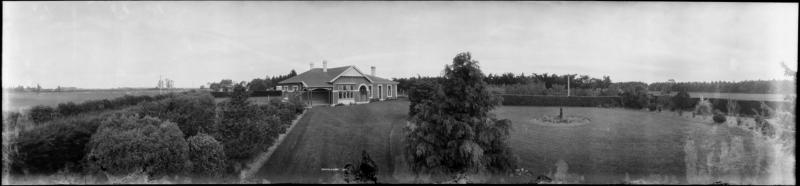
Richard William Fereday
Richard William Fereday, the son of John Turton Fereday, an ironmaster, and his wife, Ann Cecilia Heming, was born at Ettingshall, Staffordshire, England, and baptised at nearby Sedgley on 22 March 1820. After service as a law clerk he was admitted as a solicitor in 1849. He practised first in Birmingham, then for 15 years in London, where he was involved in the acquisition of land for both the London and North Western and the Midland Railway companies. On 15 March 1851 Fereday had married Mary Ann Parker Purcell at Edgbaston, Warwickshire. They emigrated to New Zealand on the Queen of the Mersey in 1862, arriving at Lyttelton on 16 October. For two years they stayed with Fereday's brother, Edwin, who farmed Oakleigh station near Southbridge, north of the Rakaia River. In 1864, after being admitted as barrister and solicitor, Fereday set up in practice in Christchurch. He became an inaugural member of the Canterbury District Law Society, serving as vice president from 1885 to 1888, and became a member of the council of the New Zealand Law Society. It was as an entomologist rather than as a lawyer that Fereday was to become best known. In England he had developed a deep knowledge of moths and butterflies, and he maintained this interest when he came to New Zealand. His first scientific paper was published in London in 1867, and by 1872–73 he was able to recognise some 300 species and had sent at least 200 specimens to scientists in Europe; most of these were new to science. This work continued throughout his life, and in his last published paper he listed 616 New Zealand species. After 1882 he confined himself to collecting and left others, especially his close friend Edward Meyrick, to supply the scientific descriptions. Fereday also made detailed observations on other insects and in 1873 noted the prevalence of various insect pests in farms and orchards. At his urging, several insect species were brought into Canterbury from England in the first such introduction of foreign species for pest control. The arrangements for this were probably made through Fereday's friends in the Entomological Society of London, of which he was a fellow. In 1877 Fereday's suggestion that government inspectors be appointed to examine incoming goods for insect pests and to effect means for their eradication was put into practice. In 1870 he had promoted the importation of bumblebees for the fertilisation of red clover. Early attempts at importation were unsuccessful and in 1883 Fereday suggested that bees could be transported in the cool-stores of ships. Bees eventually became established after being released in Christchurch in 1885. Fereday thus influenced the development of biological control and agricultural entomology in New Zealand. Fereday presented most of his collections of English and New Zealand insects to the Canterbury Museum; the remainder were purchased by the museum from his estate. The New Zealand material forms a very important early record of the country's fauna. Entomology and acclimatisation were not Fereday's only interests. In 1871 he designed a system for the supply of water to Christchurch's fire engines, and he was involved in the provision of public reserves in the proposed new townships of Malvern and Sheffield in 1873. He and his wife, Mary Ann, had a long- standing devotion to archery, and Fereday, a skilful archer, was captain of the Canterbury Archery Club from 1874 to 1885. Fereday was also a competent painter, exhibiting in many local exhibitions, and was involved in the Christchurch Exhibition of 1877. A prime mover in the formation of the Canterbury Society of Arts, he exhibited there from 1881 to 1889 and was a council member for two periods between 1884 and 1889. He exhibited in the 1885 New Zealand Industrial Exhibition at Wellington. One painting is still held by the Canterbury Museum. Fereday was a member of the board of governors of Canterbury College from 1876 to 1897 and was its representative on the Canterbury Museum's trust board for many years. He was a strong advocate of the formation of the Professorial Council, and of the development of the School of Agriculture at Lincoln. A member of the Philosophical Institute of Canterbury, he was a long-serving committee member, and chairman and president from 1883 to 1884. In 1881 he supported the establishment of a system of meteorological stations in Canterbury. Mary Ann Fereday, an active parish worker, died at Fendalton, Christchurch, on 31 May 1890; Fereday married a widow, Georgina Jemima Wood Macpherson, née Robertson, at Dunedin on 1 March 1895. He died on 30 August 1899 aged 79; there were no children of either marriage. Fereday had been one of those enthusiastic amateurs who made a considerable contribution to science in nineteenth century New Zealand.